Yesterday's post was about muscle memory. This morning I was listening to a RadioLab podcast. Yes, I know, I've posted about their show about 100 times (okay, actually maybe 3), but it's really interesting. They do both hour-long episodes which get pretty in-depth, and they also do "shorts," which are subjects that for whatever reason never made it to the hour-long version - not enough material, distraction by the producers (which they do seem prone to), etc. There are also random segments where they play music or something. It's hard to categorize the show; the best I can do is to say it's structured a little bit like This American Life (one theme, and a number or variations on that topic), but is more relaxed and fun and random. The RadioLab guys like to use sound effects and weave little snippets of interviews into their story, sometimes to move it along, sometimes as background. It's interesting stuff. Anyway....
The episode I was listening to was called Limits (you can listen to the whole show online), and the first segment was about the physical limits of the body (which is why I made the connection to yesterday's post). The first interviewee was a woman named Julie Moss. She was a P.E. (as in gym class) major in college, and decided as her senior project that she would do the Ironman Triathlon and write about the physiological effects of such an endeavor on the body. The Ironman consists of a 2.4-mile swim, a 112-mile bike ride, and a 26.2-mile run. And it's a race. It began as a challenge among a group of Navy SEALS, and is now participated in by a broader swath of people, all of whom are equally as crazy as the first SEALS were. Back to the story: Julie was going to do the Ironman as her senior project. She was fit, as a P.E. major should be, but did no specific triathlon training to speak of. Lo and behold, she found herself in the lead! She said in the interview that her motivation to keep moving was that she had to finish her school project. Witness what happened at the end of the race here.
Another interview in this segment was with Stephen Auerbach, who produced a documentary film called Bicycle Dreams, about the Race Across America. RAAM is a 3000-mile coast-to-coast bike race, with no stages and no rest days. The clock is running 24/7, so every hour a rider stops to sleep is an hour that another competitor might pass them by. Half the people who start the race don't finish, and those who do are not in good shape. Some riders' necks give out and can't hold up their heads anymore, so they tie a rope to the back of their helmet, and run it down their back to their waist or belt or the back of their seat! Just to hold their head up!
The discussion on RadioLab focused mainly on a Slovenian racer named Jure (YOO-ree) Robic. (There was also some discussion of a French guy named Patrick Autissier, but he's not quite as crazy as Jure.) Jure has now won the men's solo RAAM 5 times, most recently this year. It took him 9 days.
Earlier in the podcast, the hosts discussed this little internal regulator mechanism that we all have called the Central Governor. This governor makes your body hurt when you're spending your reserves of energy; its job is to make you stop because it wants to preserve what energy you have left. But the governor will send signals to stop way before you've actually used up all your reserves. Great athletes have mastered the art of pushing through this "stop!" message, and get another boost of energy once they reach that safety reservoir the governor is trying to protect. Crazy athletes like Jure have gone even beyond that. The RAAM riders and other extreme endurance athletes bust through that barrier, and go even further. The governor kicks in again when you've passed tired and you really feel like you're dead, like you absolutely cannot even lift a finger. This feeling is the central governor trying to save your last little drop of energy, in case you need to run for your life from a bear or something.
So, back to Jure. When he starts to hit his first wall, he has his van team drive alongside him playing Slovenian war songs (did I mention he's a soldier?). That seems to help him cross his first "stop and save your energy!" barrier. It works until he gets to Ohio or thereabouts. By this point, he's been through heat, cold, mountains, plains, dehydration, physical exhaustion - the works. After enduring all that, it's clear that the physical integrity of the athlete is strong; so now an athlete's body will send all the stress signals to the last possible point of breakdown: the mind. Hallucination ensues. Patrick saw shadows running across the road in front of his bike, and saw the trees reaching out to grab him. Stephen (the producer) also reported that riders saw secret codes in the cracks in the road, jumped off their bikes to get into a fistfight with mailboxes, and other madness. This is where a lot of people quit the ride. Jure, on the other hand, saw bearded Afghan horsemen - the mujahideen. And they were shooting at him.
So, remember how that regulator is packing away your last little bit of energy for when you need to run for your life. Well, Jure really did think he needed to bike for his life. He was convinced that he really was going to die if he couldn't get away from these guys. And his central governor really believes he's going to die too. So off he goes, biking like mad and feeling no pain, though he won't really remember it later.
It is amazing what the human body is capable of. This is fascinating stuff, people. Really.
[If you want to read more about Jure and this crazy stuff that happens to athletes like him, there is a New York Times article, and some interesting stuff in the Scientific American about the "sensed presence effect," though you can't read the whole article unless you have a subscription.]
Tuesday, August 31, 2010

Monday, August 30, 2010
Muscle Memory
A recent story on NPR discussed muscle development, and the structural changes they undergo when they are exercised. This new study suggests that muscles which are worked hard (and especially worked early in life) will be better able to regain strength, even after years of lack of use, relative to unworked muscles. Your muscles can remember their former strength!
This story reminded me of a line from one of the Lord of the Rings movies (seen them too many times, perhaps?), where Gandalf is talking to the very weakened Theoden, and suggests to him that his "fingers would remember their old strength better if they grasped [his] sword."
What the interview doesn't address, and I am curious about (assuming this is all true), is whether specific muscle movement are more easily remembered. Think of the phrase, "Just like riding a bike," which is used to explain how once you've learned something, you'll always remember how to do it. So let's say you play soccer as a kid. You start in grade school, maybe play through high school. If you spend years being lazy and then decide you want to get back in shape, will you have better luck playing soccer, or will your early-in-life fitness translate to any new endeavor you undertake?
This story reminded me of a line from one of the Lord of the Rings movies (seen them too many times, perhaps?), where Gandalf is talking to the very weakened Theoden, and suggests to him that his "fingers would remember their old strength better if they grasped [his] sword."
What the interview doesn't address, and I am curious about (assuming this is all true), is whether specific muscle movement are more easily remembered. Think of the phrase, "Just like riding a bike," which is used to explain how once you've learned something, you'll always remember how to do it. So let's say you play soccer as a kid. You start in grade school, maybe play through high school. If you spend years being lazy and then decide you want to get back in shape, will you have better luck playing soccer, or will your early-in-life fitness translate to any new endeavor you undertake?
Saturday, August 28, 2010
Four Quartets
"We shall not cease from exploration
And the end of all our exploring
Will be to arrive where we started
And know the place for the first time."
- T.S. Eliot, "Little Gidding" from Four Quartets
And the end of all our exploring
Will be to arrive where we started
And know the place for the first time."
- T.S. Eliot, "Little Gidding" from Four Quartets
Friday, August 27, 2010
What I'm Reading Now -- The Space Between Us
 This book was recommended to me by a coworker at my bookstore, and in truth, I'm almost finished with it. I started it while I was in Breck, where I made excellent progress, although I have read exactly 0 pages since my plane landed in St. Louis.
I'll reserve comments on this book until I've finished it, except to say that it's the story of two women in India, and how each one's life has crossed, paralleled, and challenged the other's.
Thursday, August 26, 2010
Waking Up
This morning I had one of those mornings. You know the kind.
You wake up, and there is a little bit of light coming through the windows. The temperature is just right - not too hot, not too cold. The bed is comfortable. The dog is apparently also having a good morning; he is still asleep on the bed.
It would be nice to relax there for a while, though that is usually not an option. But at least it was a good start.
You wake up, and there is a little bit of light coming through the windows. The temperature is just right - not too hot, not too cold. The bed is comfortable. The dog is apparently also having a good morning; he is still asleep on the bed.
It would be nice to relax there for a while, though that is usually not an option. But at least it was a good start.
Wednesday, August 25, 2010
Still More Breck Pics
It's true. I have more. I still haven't found the picture of the red and yellow paintbrush (although in truth, I haven't actually looked - when I say "I still haven't found," I mean it has not e-mailed itself to me.)
This big pile of rocks and gravel and stuff is what is called dredge spoil. There are miles of piles (I rhyme!) like this along the rivers around Breck - and maybe all over Colorado? I don't know, but probably so. 100 years ago or so, people wanting gold and other deposits built dredges on the shallow rivers out west. The dredges would churn up the bottom of a river, sifting out the good stuff, and leaving behind lots of other stuff - some just unsightly, like these rocks, and some toxic. The rocks were dumped in these enormous piles, which are still just sitting there, looking all barren and unfortunate. There is a reproduction dredge sitting in the Blue River right there in downtown Breckenridge.

One night, just before dinner, this amazing alpenglow happened, and we had a great view from the balcony!


 It looked like the mountain was on fire!
This big pile of rocks and gravel and stuff is what is called dredge spoil. There are miles of piles (I rhyme!) like this along the rivers around Breck - and maybe all over Colorado? I don't know, but probably so. 100 years ago or so, people wanting gold and other deposits built dredges on the shallow rivers out west. The dredges would churn up the bottom of a river, sifting out the good stuff, and leaving behind lots of other stuff - some just unsightly, like these rocks, and some toxic. The rocks were dumped in these enormous piles, which are still just sitting there, looking all barren and unfortunate. There is a reproduction dredge sitting in the Blue River right there in downtown Breckenridge.

One night, just before dinner, this amazing alpenglow happened, and we had a great view from the balcony!


 It looked like the mountain was on fire!
Tuesday, August 24, 2010
Inkdeath -- Take 2
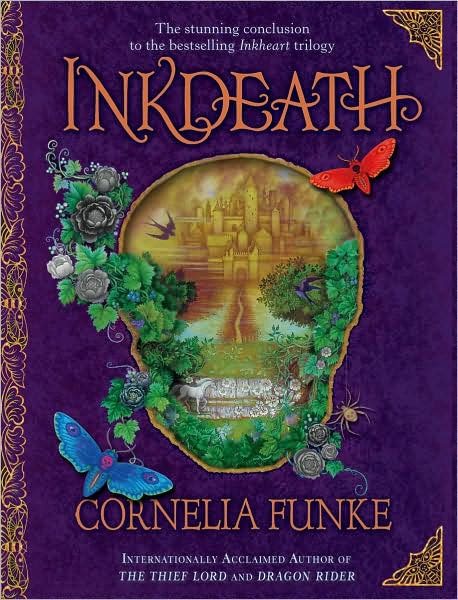 Yes, I know it took me forever to read this book. I've been very busy moving and trying to catch up on some magazines I was behind on (though I still have a lot more of both to do).
This is the last book of the Inkheart trilogy, and we pick up with our intrepid hero and heroine, father and daughter, Mo and Meggie. They are in the Inkworld, recovering from the disasters of the second book and trying to find a way home.
One thing I can say for sure about this book is that it's not for kids, despite its classification. Witness these passages and ideas, some of which are rather inappropriate for children, and some of which are just sad (even if true):
- Orpheus was "taking pleasure with one of the maids...."
- "His silver nose still looked like a beak in the middle of his face. There were tales saying that the Adderhead had ordered a silver heart to be made for his herald, too, but Fenoglio felt sure there was still a human heart beating in the Piper's breast. Nothing was more cruel than a heart made of flesh and blood, because it knew what gives pain."
- "He saw so many emotions mingled on her face: anger, disappointment, fear -- and defiance. Like her daughter, thought Fenoglio again. So uncompromising, so strong. Women were different, no doubt about it. Men broke so much more quickly. Grief didn't break women. Instead it wore them down, it hollowed them out, very slowly."
- The author quotes passages from other words at the beginning of every chapter: "'You wish for something you don't really want, the dream says. / Bad dream. Punish him. Chase him from the house. / Tie him to the horses, let him run with them. / Hang him. He deserves it. / Feed him mushrooms. Poisonous ones.' - Paavo Haavikko, 'The Trees Breathe Gently'"
- "The happiness in her voice moved him, and he wondered, not for the first time, how it was that the book that had told him so much about fire elves and giants said so little about the Adderhead's daughter. To Fenoglio, Violante had been only a minor character, an ugly, unhappy little girl, nothing more. Perhaps you could learn from her how small parts can be made into major roles of you play them in your own way."
- "Cheeseface was not alone when his bodyguard told him about his late-night visitor. There were three girls with Orpheus, none of them much older than Meggie, and they had been cooing at him for hours, telling him how clever, important, and irresistible he was. The oldest was sitting on his plump knees, and Orpheus was kissing and fondling her so grossly that Farid would have liked to strike his fingers away. He was always being sent out to bring Orpheus the prettiest girls in Ombra."
- The idea that the main character loves one of her parents more than the other.
- And the occasional curse word.
These are not things for children! I would put this book solidly in the teen category if it were up to me.
As an adult, and probably more able to understand and appreciate some of the themes than a 10-year-old would be (I hope), I really liked it. It didn't end at all how I expected, which is one of the things I like. Things weren't always happy. Sometimes the bad guys didn't get their comeuppance the way you like them to. Sometimes the characters who showed the most arrogance or hubris came out just fine. (But sometimes not.)
Then there are the trials and tribulations of love. Lots of couples in this book - old and young, married and un-. Things go well for some, and others suffer a lot of disappointment; sometimes (as is often the case in real life) the same characters experience both. This, I think, is one of the most teen-oriented parts of the book, because our teenage heroine experiences her first love, and her first failure at it.
And lastly, there is intense exploration of the ideas of fate, choice, and chance. For example, Fenoglio (referenced in some of the above quotes) wrote the book that allegedly created the Inkworld. As new characters from the "real" world enter the Inkworld, things start to go terribly awry. Fenoglio tries to fix it by rewriting the story, and having Meggie or Mo read his words to life. But there is another reader/writer who has entered the story - the proud and greedy Orpheus. He twists Fenoglio's words to change the story yet again, and eventually it spirals out of everyone's control. But was it ever in their control to begin with? How have the characters who have come into the lives of the characters changed the story, if at all? How much say do the characters have over their own actions?
As an appropriate and parting tribute, I will leave you with this quote from Inkdeath, which is terribly reminiscent of something Frodo says to Samwise Gamgee in The Lord of the Rings: The Return of the King: "He'll kill him, you wait and see," replied the Strong Man, and his voice sounded so confident that for a precious moment even Meggie forgot all her fears for Mo. But the moment passed, and once again she felt the snow on her skin, as cold as the end of all things."
Sunday, August 22, 2010
Mad Men - The Dinner Series, Part I
One of my fave TV shows, Mad Men, started up again about a month ago. Very cool. Since K is now caught up and totally into it, we decided to meet up on Sunday nights, cook dinner, and watch the show. J and A (our cousin who's in from Jeff City for a job) have joined us, and we've had loads of fun figuring out (a) what to make, and (b) how to make it. Except last night when I almost got blown up. That was slightly less fun than normal. But anyway...
Yesterday was K's choice for dinner (not the band), so we had the following menu: cheese ravioli with spinach and tomatoes; sourdough bread with ricotta, salt, and pepper (broiled - that's how I almost got blown up); and vanilla ice cream with berries and chocolate sauce. K was especially thrilled with the dessert, and insisted that I take a picture of J's partially-eaten (believe it or not!) final course. So, here it is:
 Dessert.
Yesterday was K's choice for dinner (not the band), so we had the following menu: cheese ravioli with spinach and tomatoes; sourdough bread with ricotta, salt, and pepper (broiled - that's how I almost got blown up); and vanilla ice cream with berries and chocolate sauce. K was especially thrilled with the dessert, and insisted that I take a picture of J's partially-eaten (believe it or not!) final course. So, here it is:
 Dessert.
Saturday, August 21, 2010
Other Breck Pics
Okay, I've been back through all my earlier Breck posts, and added in additional pictures where appropriate. I also have some random ones I thought I'd put up just for fun:
 Keystone enjoying life on the balcony...
 ...and close to the water bowl.

 Peaks on the way home from fishing at the Slate Hole. I didn't even take too many big-scale pictures, because you really can't capture the true sense of hugeness of space out here. But there are a few, just to try to give an idea.
 Orange Paintbrush
I also had a pic of some red and yellow paintbrush, but I can't seem to find it. I'll post it later if it turns up.
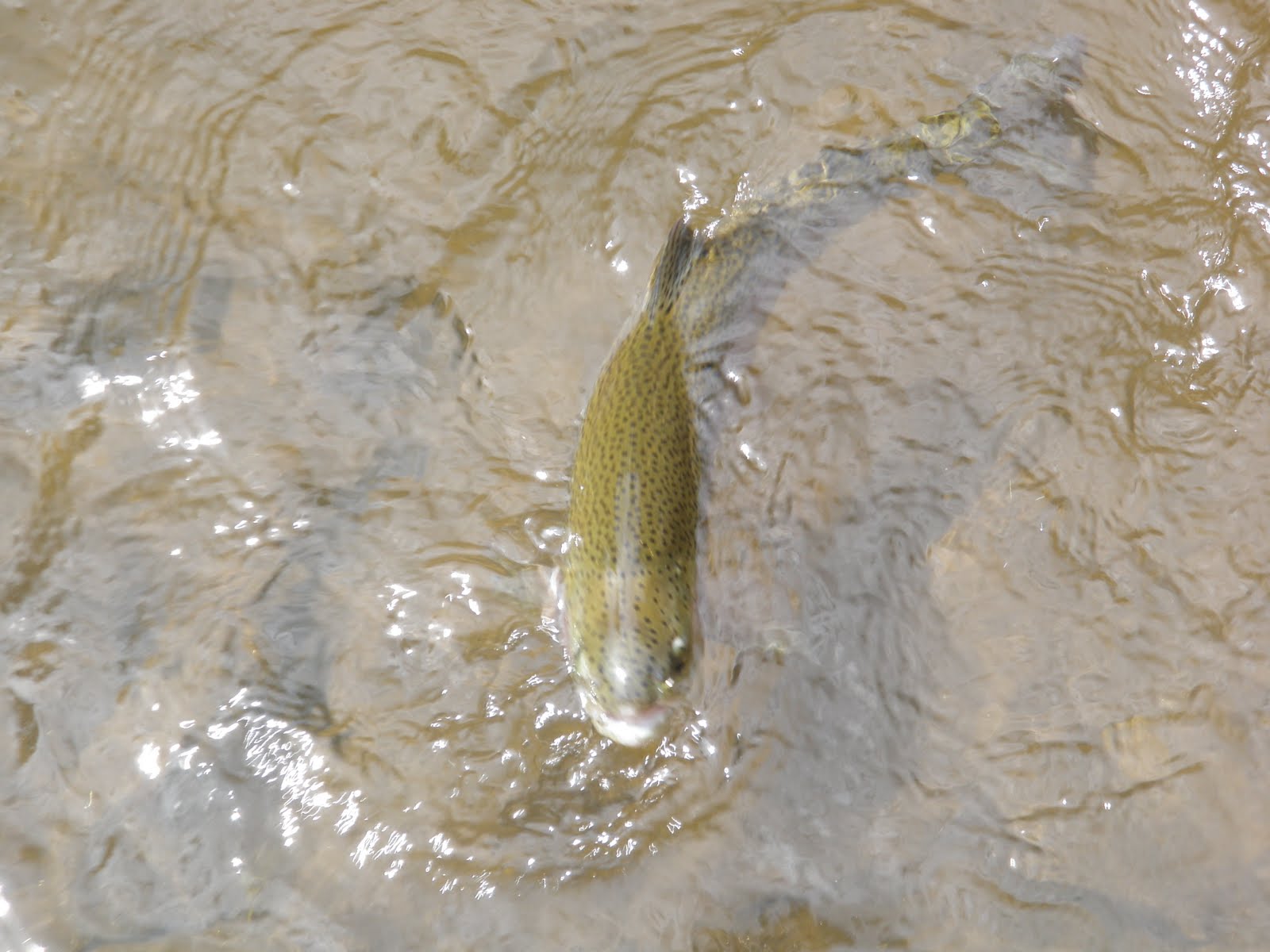
 Dad's big rainbow
T in the car
Friday, August 20, 2010
Flaco's Cocina
Last night J and I went to Flaco's Cocina for a late dinner. This place is a curiosity to me. I have been there twice now - once for happy hour (on a Tuesday or Wednesday, if I recall correctly), and now for dinner on a Thursday. And both times I've been there, I'm pretty sure there were more employees than there were customers.
The place is tiny - probably 10 small tables, and maybe a dozen bar stools - and it seems like the employees just congregate around the end of the bar and chat. This is not to say that the service was bad or they were ignoring us; it just seems odd to have them all standing around. Although I guess if there aren't that many customers, they probably don't have much to do. Although it's been open for business the entire 3-1/2 years since I discovered it (although I didn't go there for the first time until less than a year ago), so I'd think they have to be making at least a little money, no?
We started out our meal with queso and chips as an appetizer. And the queso? It was real cheese. Not nasty melt-y cheese sauce stuff that came out of a can. But real cheese that had been in the oven (I burned my tongue). The chips were just-greasy-enough house-fried tortilla chips, and were far tastier than the dried-out chips and salsa you get at most places. The fajitas (braised carnitas) were also delicious. We got a portion for two, and it was more than enough for both of us! (However, our waiter said we would get 8 tortillas, and we only got 7. I know this because I can do math. Last night, we each had 2. That makes 4. Today for lunch, I had 2 more. That makes 6. But there's only 1 left. So: 7, not 8.) Maybe the take-away lesson is that people who make good food can't necessarily count. But hey, when you get more food than you can eat in three meals, who the heck cares, really?
The place is tiny - probably 10 small tables, and maybe a dozen bar stools - and it seems like the employees just congregate around the end of the bar and chat. This is not to say that the service was bad or they were ignoring us; it just seems odd to have them all standing around. Although I guess if there aren't that many customers, they probably don't have much to do. Although it's been open for business the entire 3-1/2 years since I discovered it (although I didn't go there for the first time until less than a year ago), so I'd think they have to be making at least a little money, no?
We started out our meal with queso and chips as an appetizer. And the queso? It was real cheese. Not nasty melt-y cheese sauce stuff that came out of a can. But real cheese that had been in the oven (I burned my tongue). The chips were just-greasy-enough house-fried tortilla chips, and were far tastier than the dried-out chips and salsa you get at most places. The fajitas (braised carnitas) were also delicious. We got a portion for two, and it was more than enough for both of us! (However, our waiter said we would get 8 tortillas, and we only got 7. I know this because I can do math. Last night, we each had 2. That makes 4. Today for lunch, I had 2 more. That makes 6. But there's only 1 left. So: 7, not 8.) Maybe the take-away lesson is that people who make good food can't necessarily count. But hey, when you get more food than you can eat in three meals, who the heck cares, really?
Subscribe to:
Posts (Atom)